
Ant Farm is a live, deterministic model of AegisGenera's agent-to-agent routing rules, drawn as street traffic. Every message is a car. Every lane cell holds one car. Every visitor gets a private colony to jam, deadlock, isolate and repair.
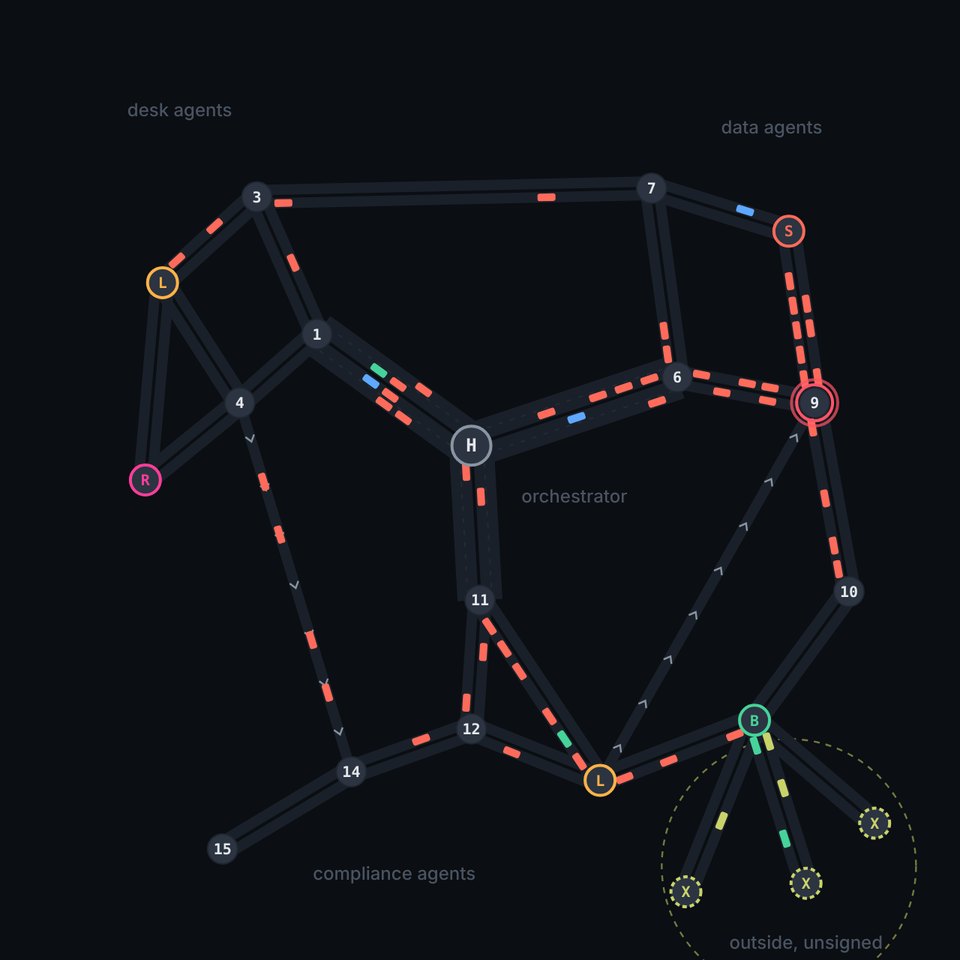
Ant Farm is a semantic model: it states AegisGenera's routing rules precisely enough to run them, watch them, and attack them. The gateway acts as a reference monitor. Every message is checked against Passport's edge and verb maps; delegation is checked against the originator's rights; replies must answer a real request; and hop limits, rate limits, a message deadline and revocation all apply.
It is not a throughput benchmark and not the formally proved production core. Real-workload performance numbers come from real agents on the real gateway. What the model offers instead is human-understandable agent activity that can be constrained, and a headless engine that runs the same rules under a fuzzer.
The agents follow simple rules. A loop pair answers each other twice per message. An alarm storm relays every alert to two peers. Each individual message passes every check at the gateway, and the colony still jams, the way army ants following one another's trail can circle until they die.
Under plain shortest-path routing, overload goes further: cars end up waiting on each other in a circle, and nothing moves again. With the storm and loop running and no limits, shortest paths deadlocked in 50 of 50 seeded runs. With Autonet up*/down* routing, from DEC's Systems Research Center, it deadlocked in 0 of 50.
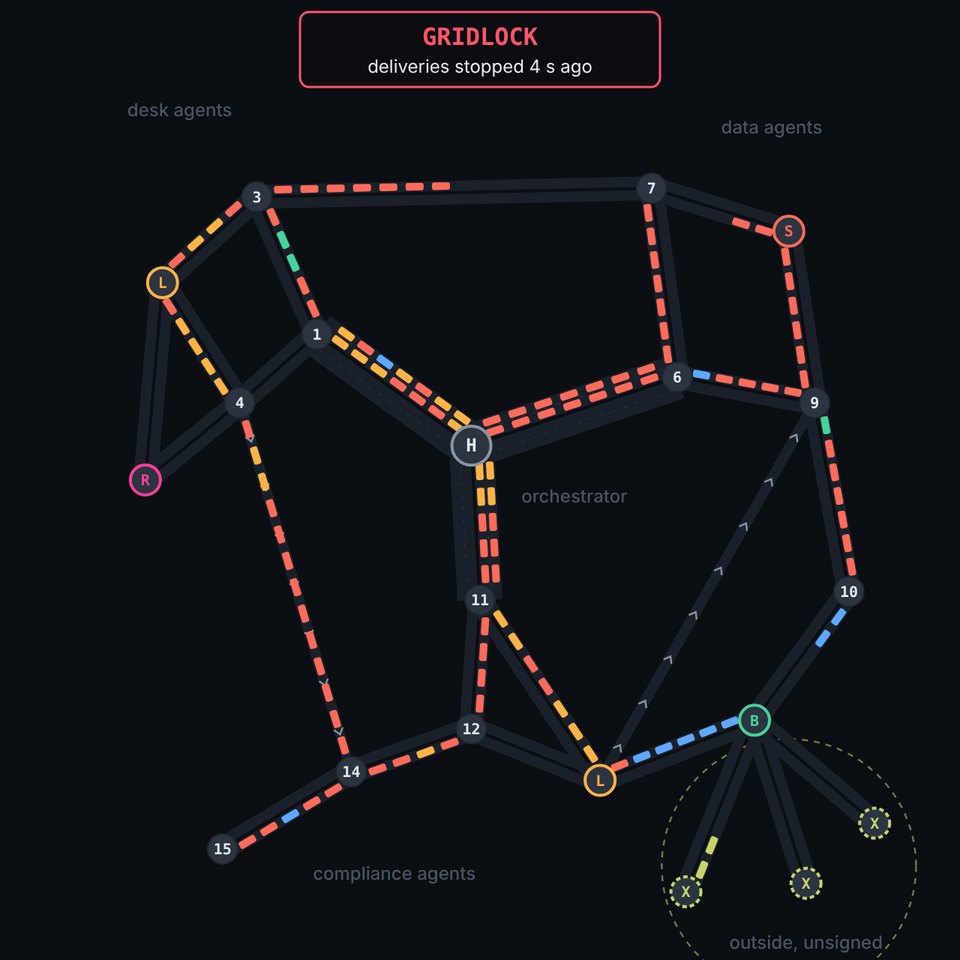
Any road can be stopped by pulling its Andon cord, the Toyota Production System's line-stop. Isolating a neighbourhood pulls every road across its boundary. A global policy decides what happens to messages already on a pulled road:
| Policy | Messages on the pulled road |
|---|---|
| Hold | Stop in place and keep their position; resume on release. Nothing is lost. |
| Drain | Clear the road, then follow the new routes. Nothing new enters. |
| Reject | Removed and refused back to the sender, who decides whether to retry. |
Under Autonet routing, random cord pulls during an unconstrained storm produced 0 deadlocks in 300 runs across all three policies; shortest paths deadlocked in about 4 of every 10. Timing matters more than policy: isolating a storm half a second after it starts contains it completely. Fourteen seconds later, it has escaped.
Inside agents are trusted: each signs every message it sends. Outside agents are unsigned and stay outside the graph; Passport gives each exactly one edge, to a border agent. The border never forwards. It asks inside under its own name, picks a responder by capability, and maps the reply back. An outside identity never travels inward.
All three outside agents flooding at once cost the interior about 4% of its useful work. The flood meets the border's own rate budget; everything else receives a definite "no feasible responder".
One trusted agent turning storm did far more damage. Revoking it made things worse for several seconds: its alarms kept relaying through agents each authorized to relay. The hop limit drained them.
Do not ask whether the agent is trustworthy. Ask what the graph permits it to reach when it is not.
Every check the gateway makes is one term of a single predicate. A request is admitted only if the plan it belongs to is in the feasible set at that moment:
| Term | Meaning | In the model |
|---|---|---|
| E evidence | Signed, attested, not revoked | Signature check, revocation by epoch |
| B boundary | CRC topology | Perimeter, isolation |
| A authority | Passport | Edge and verb map, confused-deputy check, reply tracking |
| R resources | Bounded consumption | Hop limit, rate limits, queue space, deadline |
| H halt | Andon | Pulled roads and isolation |
Pulling a cord can only shrink F(t), never grow it. Every request ends in a definite outcome: delivered, denied with a reason, refused, expired, or "no feasible responder". Capability discovery asks the same test about each candidate responder, so it never offers one the gateway would refuse.
The same engine runs headless under a fuzzer: 100 random schedules of toggled constraints, behaviours, revocations, cord pulls and isolations, with every invariant checked on every tick. To prove the checks aren't vacuous, each rule is then deliberately broken in turn, and the fuzzer must catch it.
ANT FARM SELF-TEST · v0.6.0

Random schedules:          100 × 600 ticks
Messages accepted:         132,777
Invariant violations:      0

Deliberate rule breaks:    14
Caught by the fuzzer:      14

Deadlock, unconstrained storm:
  shortest paths           50 / 50
  Autonet up*/down*         0 / 50

Same seed, same digest:    identical
The colony's graph (agents, Passport edges, roads, CRC surfaces, Andon state) moves into AletheiaGraph. Every admission decision can then be explained edge by edge, the way a database explains a query plan, and an agent's exposed graph, everything it could reach, can be queried before and after CRC constraints.
The live demo lists the research questions this work raises, each marked as shown in the model, partly shown, or open, with prior art. Among them: deadlock-free rule changes while traffic flows, automatic Andon triggers, per-message signcryption for agent traffic, attenuable delegation, discovery that leaks nothing, and colonies federated under a marshaller.